Cold snaps below 0°F kill more car batteries than any other single cause, and jump-starting one wrong in freezing temperatures can crack a battery case or fry a sensitive alternator. This guide walks through the exact order of operations that keeps you and your electronics safe when the mercury drops in 2026.
- Warm a frozen battery for 5-10 minutes before connecting cables — cold electrolyte can crack under a jolt.
- Connect positive-to-positive first, negative to an unpainted metal ground, never the dead battery's negative post.
- A battery below 20°F surface temperature loses roughly 60% of its cranking power, per widely cited AAA cold-weather testing.
- If the engine won't turn over after two tries, stop — call a 24/7 roadside service like Litro instead of forcing it.
Why this matters
A fully charged battery at 80°F cranks an engine with ease. Drop that same battery to 0°F and it delivers roughly 40% of its rated power while the engine itself needs almost double the force to turn over thickened, cold engine oil. That gap is why dead batteries spike every winter in Almaty and across Kazakhstan and Uzbekistan the moment temperatures dip below freezing.
Jump-starting in the cold isn't just "do the summer procedure faster." Cold batteries can have frozen or slushy electrolyte, brittle plastic cases, and weaker terminal connections — all of which raise the risk of a spark, a crack, or a fried control module if you connect cables in the wrong order. If your battery has been dead for more than a few hours in sub-zero weather, a 24/7 roadside team that carries proper jump-start equipment is often the safer call than doing it yourself on the shoulder.
What you'll need
- A set of jumper cables rated for at least 4 gauge (heavier gauge moves more current, which matters more in the cold)
- Two vehicles, or one vehicle and a portable jump-start battery pack
- Work gloves (rubber-lined if you have them — battery acid and cold metal don't mix well with bare hands)
- Safety glasses, especially if the battery has visible corrosion or swelling
- A phone with a saved number for backup roadside help in case the jump doesn't take
- 10-15 minutes of patience — rushing a cold jump-start is how terminals get crossed
The steps
1. Check the situation before you touch a cable
Look at the battery case for cracks, bulging, or frost buildup on the terminals before doing anything else. A battery that's visibly swollen or leaking should not be jump-started at all — it can rupture under load, and this is where a call to a roadside service beats a DIY attempt.
Frost or a thin layer of ice on the terminals is common in 2026's winter conditions and isn't automatically disqualifying, but wipe it off first so you get a clean metal-to-metal connection. A loose or corroded terminal is the single most common reason a jump-start fails on the first try.
Common mistake: skipping this check and connecting cables to a cracked case, which risks acid spray when current starts flowing.
2. Warm the battery before connecting anything
If the battery has been sitting in sub-zero temperatures overnight, the electrolyte inside can partially freeze, and cold, brittle plastic is more prone to cracking under the sudden jolt of jump current. Popping the hood and letting the engine bay sit for 5-10 minutes (engine off, just ambient exposure reduction) helps, and running the working vehicle's heater toward that side of the engine bay for a few minutes speeds it up.
Never pour hot water directly on a frozen battery — thermal shock cracks cold plastic cases almost instantly.
Common mistake: jumping a battery that's frozen solid, which can cause the case to split when current surges through frozen electrolyte.
3. Position the vehicles and kill the ignition
Park the working vehicle close enough that the cables reach both batteries without stretching, but keep the cars from touching. Shut off both engines, set both parking brakes, and turn off every accessory — headlights, heater fans, radios — in both vehicles before you touch a single clamp.
This matters more in cold weather because a fully drained battery under load from a running heater fan draws down the donor battery faster, sometimes leaving you with two dead cars instead of one.
Common mistake: leaving the radio or heater running in the dead car, which pulls extra current the moment you make the connection.
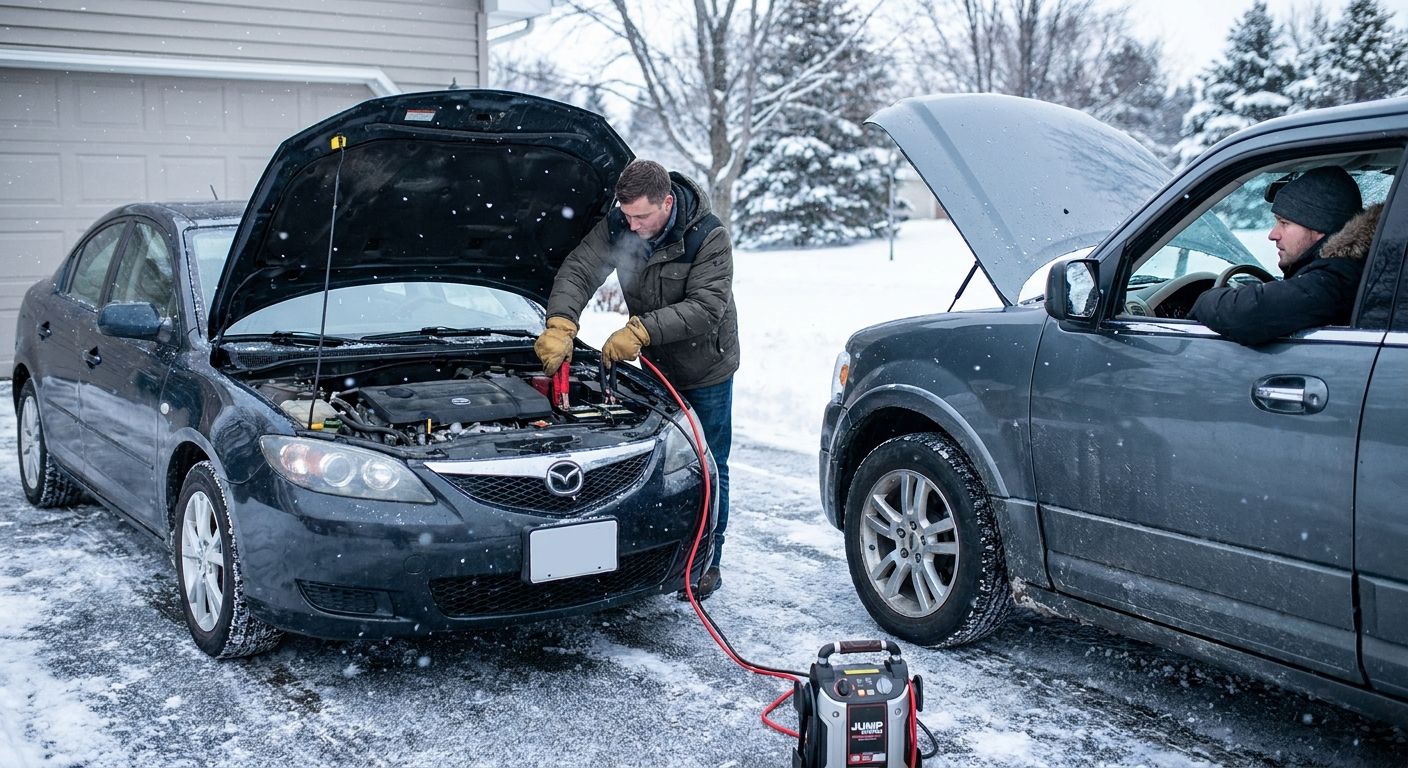
4. Connect the cables in the correct order
The order is the part people get backwards when they're cold, gloved, and rushing. Follow this exact sequence:
- Red clamp to the dead battery's positive (+) terminal
- Red clamp to the working battery's positive (+) terminal
- Black clamp to the working battery's negative (-) terminal
- Black clamp to an unpainted metal surface on the dead car's engine block — not the dead battery's negative post
That last step is the one most drivers skip. Grounding to the engine block instead of the battery's negative post keeps any spark away from the battery itself, which matters more when cold has made the case brittle.
Common mistake: connecting both negative clamps directly to the batteries, which sparks closer to the battery and raises the risk of ignition if hydrogen gas has built up.
5. Start the working vehicle first
Let the donor vehicle idle for 2-3 minutes before attempting the dead car. This lets some charge transfer through the cables and gives the dead battery a head start, which matters in cold weather when internal resistance is already higher.
Rev the working engine slightly, to around 1,500-2,000 RPM, during this window to push more amperage across.
Common mistake: jumping straight to starting the dead car with no warm-up period, which often results in a slow crank that drains the donor battery too.
6. Start the dead vehicle
Turn the key and crank for no more than 5-8 seconds at a time. If it doesn't fire, wait 30 seconds before trying again — repeated long cranks in the cold overheat the starter motor and can further stress a weak battery.
If it hasn't started after two attempts, stop. Continuing to crank a battery that won't take a charge risks starter damage and wastes the donor vehicle's charge too. This is the point where calling a roadside service, rather than a third or fourth attempt on the shoulder, saves the day.
Common mistake: cranking continuously for 15-20 seconds hoping it eventually catches — it rarely does, and it heats the starter past safe limits.
7. Disconnect in reverse order
Once the dead car is running, remove the cables in the opposite sequence from how you connected them: black from the engine block, black from the working battery, red from the working battery, red from the dead battery. Keep the clamps from touching each other or any metal while you coil the cables.
Common mistake: yanking cables off in random order, which can cause a spark near a battery that's already under stress from the cold.
8. Drive to recharge
A jump-start doesn't recharge the battery — it just gets the alternator running so it can recharge it. Drive for at least 20-30 minutes on a route with minimal stop-and-go before shutting the engine off again, especially in 2026's colder months when a short trip alone won't put enough charge back in.
If the car won't restart after being shut off again within a few hours, the battery itself likely needs replacing, not another jump.
Troubleshooting
The dead car cranks but won't fire. This usually points to a fuel or ignition issue unrelated to the battery, not a bad jump. Don't keep cranking — get it looked at before draining both batteries further.
The jump works but the car dies again within an hour. The alternator likely isn't charging the battery, or the battery itself can no longer hold a charge. Cold weather exposes a marginal battery that limped through fall — plan on a replacement.
Cables spark when you connect them. A small spark at the final connection point is normal. A large spark or continuous sparking means a wrong connection point or a short — stop and recheck every clamp before proceeding.
The donor vehicle's battery drains too. This happens when the dead battery is severely discharged and pulls too much current. Let the donor idle longer between attempts, or switch to a portable jump-start pack instead.
Terminals are too corroded to get a clean clamp. Frost and corrosion combined block current flow even with a perfect connection. Scrape the terminal lightly with a wire brush or the edge of a key before clamping on.
Nothing happens at all, no clicking, no lights. This points to a fully dead battery or a bad ground somewhere else in the car, not something a standard jump-start fixes. This is the scenario where a roadside call beats another 20 minutes on the shoulder in the cold.
Tools and resources
- Heavy-gauge jumper cables (4-gauge or thicker) kept in the trunk year-round, not just when a cold front is forecast
- A portable jump-start battery pack as a backup when a second vehicle isn't around
- A wire brush or terminal cleaning tool for corrosion buildup common after Almaty winters
- A saved contact for a roadside assistance and auto club plan — Litro's model covers jump-starts, towing, tire help, fuel delivery and legal auto advocate support under one subscription, which matters more in winter when battery failures cluster
- A basic tire pressure gauge, since cold air drops tire pressure at the same time batteries weaken
What to do next
If your battery has failed more than once this winter, the fix usually isn't another jump — it's a battery test or replacement before the next cold front hits. A subscription-based auto club plan through a roadside service covers the jump-start itself so you're not standing on the shoulder in freezing temperatures figuring out cable order from a phone screen with numb fingers.
FAQ
What's the safest way to jump start a car in cold weather?
Warm the battery for 5-10 minutes, connect red-to-red first, then black to the working battery and black to an unpainted metal point on the dead car's engine block, never to the dead battery's negative post. This grounding order keeps sparks away from a cold, brittle battery case.
How long should you let a car run after a jump start in winter?
Drive for at least 20-30 minutes on a route with minimal stopping so the alternator can rebuild the charge a jump-start doesn't provide on its own. A short 5-minute trip in cold weather usually isn't enough to prevent the battery from dying again.
Can extreme cold damage a car battery permanently?
Yes, a battery that's frozen solid or repeatedly drained in sub-zero temperatures can develop internal damage that no amount of charging fixes. If a battery dies more than twice in one cold season, it's likely due for replacement rather than another jump.
Is it bad to jump start a car when the battery is frozen?
Jump-starting a fully frozen battery risks cracking the case since frozen electrolyte doesn't conduct current evenly. Let the battery warm to at least a partial thaw near the engine bay before attempting a jump.
Why does a car battery die faster in cold weather?
Cold temperatures slow the chemical reaction inside the battery, cutting cranking power by roughly 60% at 0°F according to widely cited AAA cold-weather testing, while the engine itself needs nearly double the power to turn over thickened oil.
How much does it cost to get a jump start from a roadside service?
Costs vary by provider and whether you're on a one-time call-out or a subscription auto club plan — check current pricing directly with the service. A subscription model like Litro's bundles jump-starts with towing and tire help rather than charging per incident.
What's the correct order to connect jumper cables?
Red to the dead battery's positive terminal first, then red to the working battery's positive terminal, then black to the working battery's negative terminal, and finally black to an unpainted metal surface on the dead car's engine block. Reverse the exact order when disconnecting.
Should you call roadside assistance instead of jump-starting yourself in winter?
Call roadside assistance if the battery case looks cracked or swollen, if two jump-start attempts fail, or if you're stuck somewhere unsafe to work on the shoulder. A 24/7 roadside team carries proper equipment and avoids the risk of a DIY jump gone wrong in freezing conditions.
One last thing
The detail most drivers miss: a battery that tests fine in September can fail by January without ever being replaced, because cold exposes weak cells that summer heat masks. If your battery is more than three winters old going into 2026, get it load-tested before the first hard freeze rather than after the third jump-start of the season.